Bringing science out of textbooks, into students' hands
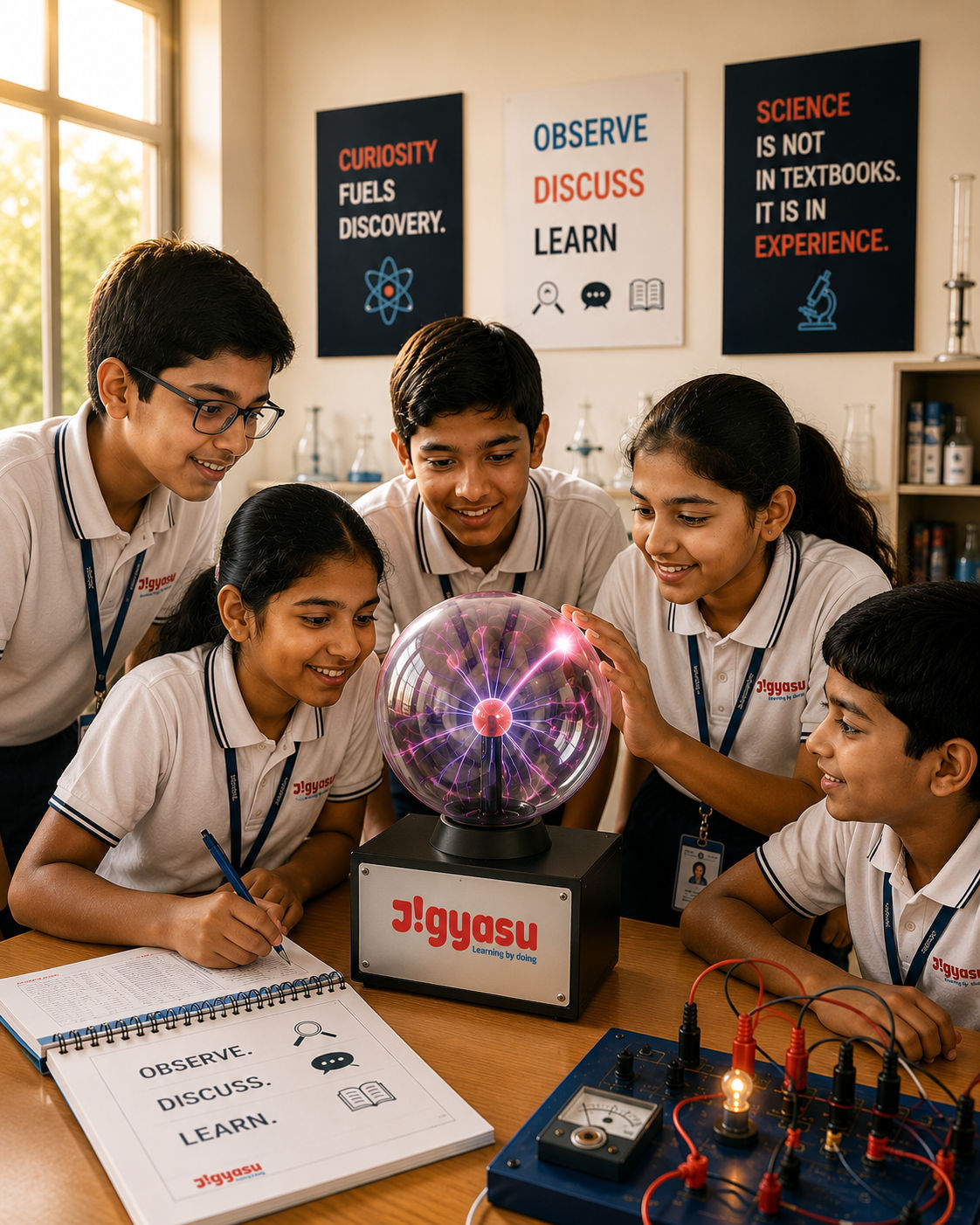
Students Engage with divergent phenomena through “magic trick” type activities, Observe textbook concepts live with demonstration models, and Explore by discussing and assimilating what they see, confirming or challenging explanations through hands-on experiments.
- 800+ innovative experiments mapped to CBSE, ICSE, IB and state board syllabi across India
- Designed by IIT alumni
- Every experiment designed around Engage · Observe · Explore
- Taught through Active Learning methodology
Trusted by 100+ schools across India
“I hear and I forget. I see and I remember. I do and I understand.”
Students learn science by experiencing it
Students learn science from the real thing: real experiments and real phenomena, live in the room. Not by listening to lectures and taking notes, and not from videos and diagrams alone.
Three ways in. The same experiments and teaching.
Every experiment is mapped to your syllabus, so teachers don't have to choose between completing the syllabus and running experiments: they get both. And whichever you choose, every experiment is designed around Engage · Observe · Explore and taught through Active Learning.
The Foundation Program
Jigyasu's after-school experiential science program. Our instructors run hands-on sessions on your campus through the year, so students who want more than one period can go deeper into Physics, Chemistry, Biology and Robotics & AI, with nothing upfront for your school.
- Where
- On your campus, after school
- Grades
- Grades 6–10
- Subjects
- Physics, Chemistry, Biology, Robotics & AI
- Session
- 90 minutes, three or four experiments on one concept
- Year
- The full academic year
- Run by
- Jigyasu instructors, one per subject
Science Studio
The space for experiential science in your school, with experiments mapped to your syllabus, teacher manuals and training. Your teachers run it.
- Who teaches
- Your teachers, trained by Jigyasu
- Grades
- Grades 6–12 (Pro adds Grades 1–2)
- When
- In your timetable
- How the school pays
- One-time purchase
Lab-in-a-Class
Experiential science in any classroom: a movable kit of 50+ experiments your teachers run, trained by Jigyasu.
- Who teaches
- Your teachers, trained by Jigyasu
- Grades
- Grades 6–12
- When
- In any classroom
- How the school pays
- One-time purchase
Surprise them, show it live, then let them test it.
Every Jigyasu experiment is designed around these three. Whichever experiment students do, it makes them engage, observe or explore, and often all three.
Engage
Spark curiosity
Students engage with divergent phenomena through “magic trick” type activities: something happens that they didn't expect, and they want to know why.
Observe
See the concept live
Students observe textbook concepts live with demonstration models, seeing the idea work instead of only reading about it.
Explore
Test it yourself
Students explore by discussing and assimilating what they see, confirming or challenging explanations through hands-on experiments.
In the classroom, we teach through Active Learning methodology. About three-quarters of every session is students thinking, discussing and explaining, not listening.
What a Grade 6 science period looks like
Grade 6 · Curiosity, Chapter 4 "Exploring magnets" · sections 4.3–4.4
Students believe a compass simply "points north".
- EngageThe teacher hangs a bar magnet on a string. However it's turned, it swings back to north–south on its own, just like the compass.
- ObserveStudents magnetise a plain needle themselves with about 30 strokes, float it on a cork in water, and watch it turn north. In groups, they work out what changed inside the needle.
- ExploreThen the real question: if the Earth is a giant magnet, why isn't every iron rod a magnet? Groups research it and explain their answer to the class.
What learning by doing gives your students
Abstract concepts made visible
Hard-to-imagine ideas like current, force and rays of light become something students have seen happen.
Experimental skills
Students learn to set up, measure, observe and infer: the core of scientific thinking.
Understanding that lasts
A concept students have experienced stays learnt, not crammed the week before the exam.
Science in everyday life
Students start connecting what they learn in class to what they see around them.
Built by physicists and educators: founder Satwik Das (IIT Kharagpur, 20+ years teaching physics), Chief Learning Officer Arun Elassery (IIT Kharagpur) and Co-Founder Lipi Das.
Meet the teamCommon questions about Jigyasu
See a Jigyasu session in your school
Book a demo. We'll visit your school, show you a session, and help you pick the right way to start.